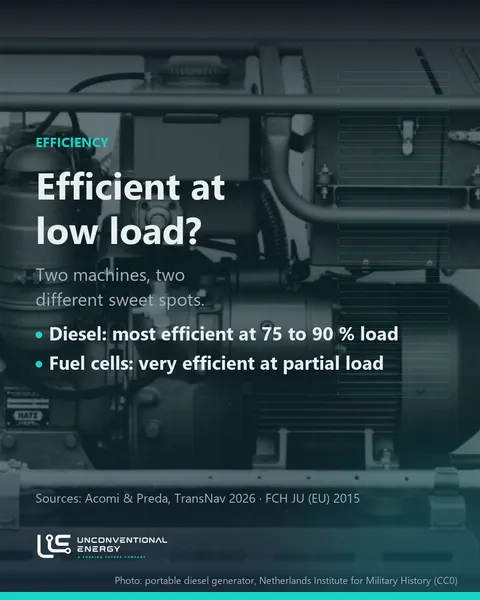
The fuel cell in a hydrogen fuel cell generator stays efficient at partial load, where a diesel generator loses out. A 2015 study for the EU's Fuel Cells and Hydrogen Joint Undertaking says fuel cell systems reach electrical efficiencies of up to 60 % and still operate very efficiently at partial loads. The figure for one generator depends on its size and design.
Why low load matters
A diesel generator is most efficient at 75 to 90 % of its rated load, a 2026 study of ship generators from Constanta Maritime University in Romania found. Keeping the load in that range also prevents the engine wear known as wet stacking.
A fuel cell works the other way. The EU study notes that fuel cells tolerate a lot of change in their output, because they still operate very efficiently at partial loads.
When a battery is the better choice
If the grid is close, charging a battery from it loses less energy than making hydrogen first. A fuel cell generator fits sites far from the grid, where the fuel has to be brought in and the load is often small.
Sources: Fuel Cells and Hydrogen Joint Undertaking, Advancing Europe's energy systems: Stationary fuel cells in distributed generation (Publications Office of the European Union, 2015). N. Acomi and A. Preda, Operational Optimization of Parallel Diesel Generator Systems, TransNav, 2026. Updated 24 November 2026.